The origin of Bich Dong Pagoda dates back to 1428 during the early period of the Later Le Dynasty. At that time, it was only a small pagoda located on the top of the mountain. In 1705, two Buddhist monks named Tri Kien and Tri The, from Nghia Hung District in Nam Dinh Province, met each other and became sworn brothers. Both monks were devoted to Buddhism and traveled to many places to spread Buddhist teachings and build temples. When they arrived at this area, they were deeply impressed by the beautiful landscape of Bich Dong Mountain and noticed that an old pagoda already existed there. They decided to stay, repair the old pagoda, and call for donations to rebuild the temple complex. As a result, three pagodas were constructed for religious practice: Ha Pagoda, Trung Pagoda, and Thuong Pagoda. In 1707, the two monks also cast a large bronze bell, which is still preserved and hangs in Dark Cave.
In 1774, Lord Trinh Sam visited the area. After admiring the scenery of mountains, caves, rivers, fields, and lush green vegetation surrounding the pagoda, he was greatly impressed by the harmonious beauty of the landscape. Because the mountains, trees, and pagoda were all covered in green, he gave the pagoda the name “Bich Dong,” which means “Green Pearl Cave.”
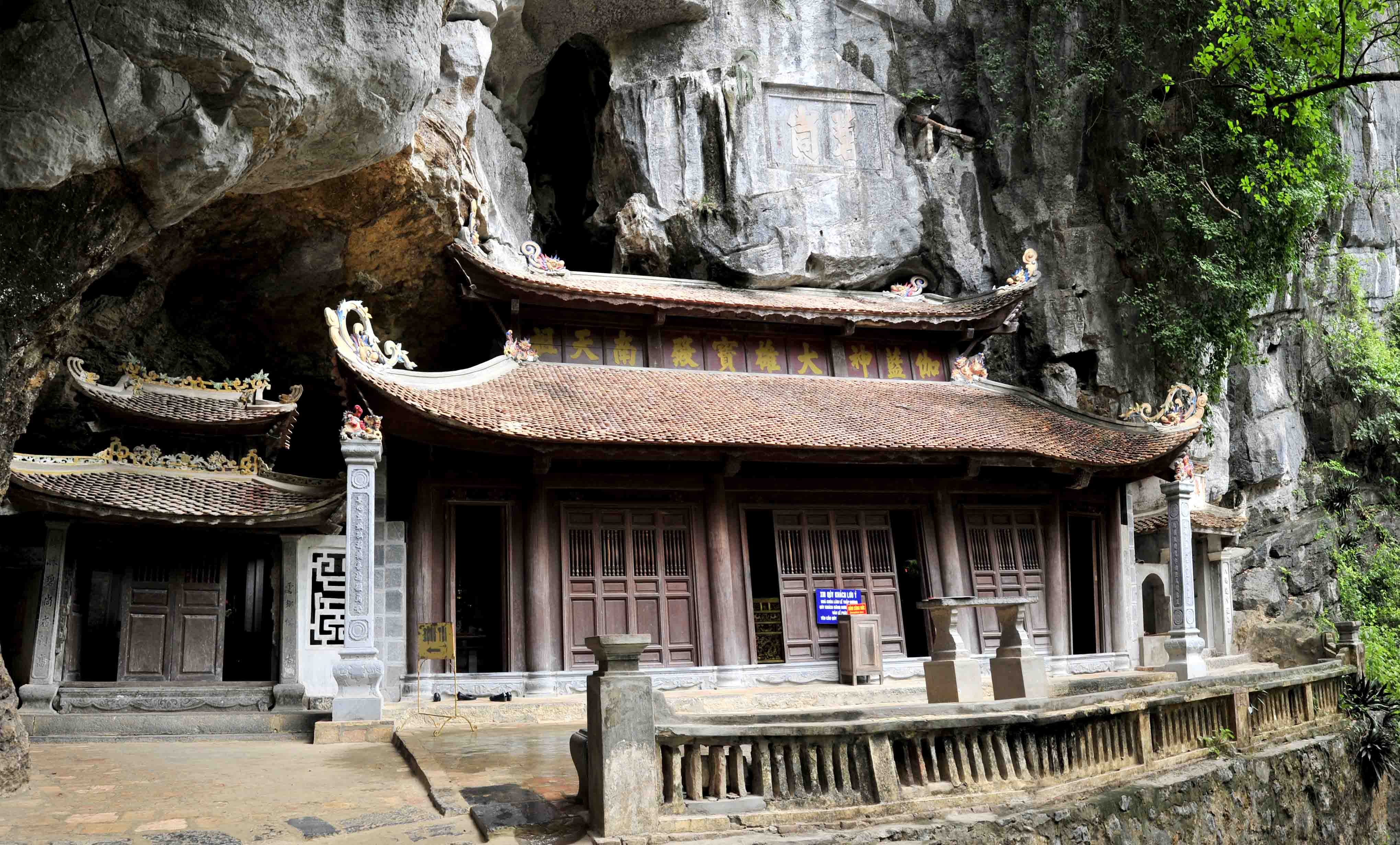
Bich Dong Pagoda is a traditional Vietnamese architectural work. Like many ancient pagodas, it was built mainly with ironwood and covered with traditional curved roof tiles. The roofs have elegant curved corners shaped like the tail of a phoenix, creating a graceful and flowing appearance similar to waves or the wings of a flying bird. Seen from a distance, the pagoda looks like a dragon boat floating gently among the mountains.
The pagoda complex was built in the shape of the Chinese character “Tam,” meaning three parallel structures. These structures are not connected but are arranged along the mountainside from low to high, forming three separate temples: Ha Pagoda at the foot of the mountain, Trung Pagoda halfway up the slope, and Thuong Pagoda near the top of the mountain. Beneath the mountain is Xuyen Thuy Cave, a water cave about 350 meters long that runs through the mountain and contains clear underground water.
Ha Pagoda has five compartments and is built on a high foundation at the foot of the mountain. It is dedicated to the Buddha. The architectural layout follows the traditional “Dinh” style. The beams, columns, and roof structures are made from ironwood. The pagoda roof has two curved layers with eight roof surfaces. The stone pillars in Ha Pagoda are made from single solid blocks of stone more than four meters high.
From Ha Pagoda, visitors climb about 120 stone steps arranged in an S-shaped path to reach Trung Pagoda, located halfway up Ngu Nhac Mountain. On the mountain wall in front of the pagoda, the words “Bich Dong” are carved into the rock. Trung Pagoda is very unique because half of the temple is built inside a natural cave while the other half is open to the outside. The pagoda has three compartments for worshiping Buddha. About six meters above Trung Pagoda is Dark Cave, the main cave of the area. It is a quiet and mysterious space that stretches deep into the mountain and is slightly inclined toward the east. The cave is long and wide, with lighting inside, and the rock formations create a magical atmosphere that resembles a fairy-tale world created by nature.
To reach Thuong Pagoda, visitors must climb nearly forty more stone steps along the mountainside. Thuong Pagoda, also called Dong Pagoda, is dedicated to Avalokitesvara Bodhisattva. It is located at the highest position near the summit of Bich Dong Mountain. From this pagoda, visitors can enjoy a wide view of the surrounding landscape. In the distance, five separate mountains stand facing Bich Dong Mountain like five lotus petals. This mountain group is known as Ngu Nhac Son.
Bich Dong Pagoda represents an important cultural and spiritual symbol of the local community. It reflects traditional Vietnamese religious life and plays a significant role in the cultural heritage of Hoa Lu. The pagoda harmoniously blends ancient architecture with the peaceful natural scenery of mountains, caves, rivers, and rice fields. This combination of human creativity and natural beauty contributes greatly to the overall charm of the Tam Coc – Bich Dong landscape, making it one of the most remarkable destinations in Ninh Binh Province.