Thai Vi Temple is located in Van Lam village, Nam Hoa Lu ward, Ninh Binh province. It is an important historical and cultural relic and also a destination on the Tam Coc – Bich Dong cultural and ecological tourism route. The temple was built by local people around the 13th century. It is a place dedicated to the kings of the Tran dynasty, the generals of the Tran dynasty, and Queen Thuan Thien. The temple stands on the foundation of Vu Lam Palace, which was once a military base during the second resistance war of the Tran dynasty against the Yuan–Mongol invaders.
Visitors enter the temple through the Nghi Mon gate. After walking a short distance, they can see a two-storey bell tower on the right side. The tower has eight symmetrical roofs built in a traditional layered architectural style. It is made entirely of ironwood. The roofs are covered with traditional curved tiles, and the corners curve upward like the tail of a phoenix. Inside the tower hangs a bronze bell that was cast in 1689.
Opposite the bell tower along the main pathway stands a stele tower together with three stone steles placed on both sides. The stele tower has four sides and was built in 1926. The inscriptions on the steles record the years when Thai Vi Temple was restored and repaired, as well as the contributions of people who donated money and materials for the construction and maintenance of the temple.
The main pathway and the Dragon courtyard are paved with green stone. The courtyard covers an area of about 40 square meters. On both sides of the courtyard there are two rows of Vong houses. In the past, these buildings were places where elders and participants waited before entering the temple to perform ceremonial rituals.
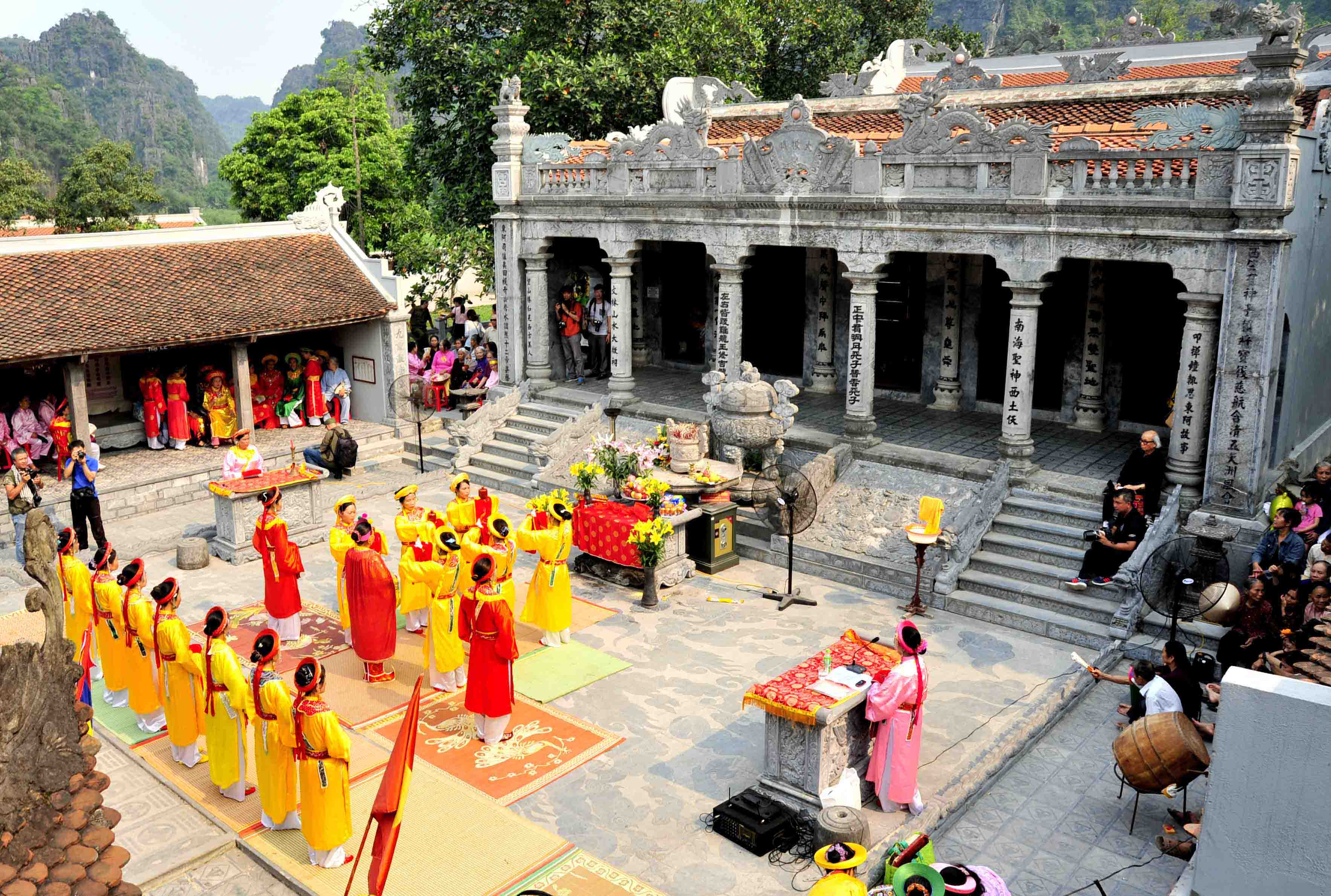
From the courtyard, visitors walk up stone steps about 1.2 meters high to reach the Ngu Dai Mon, or the Five Great Gates. This impressive structure has six rows of round stone pillars arranged in parallel lines. Each pillar is carved with images of dragons facing toward the main sanctuary.
Beyond the gate stands the Bai Duong, or the front hall. Above the hall hangs a red and gold lacquered board bearing four Chinese characters meaning Long Duc Chinh Trung. The front hall is supported by six square stone pillars. Behind it is the Trung Duong, or the middle hall, which has two rows of round stone pillars with four pillars in each row. These pillars are carved with traditional symbolic animals such as dragons, kylins, turtles, phoenixes, and images of carp transforming into dragons.
The main sanctuary also has eight round stone pillars carved with the symbols of music, chess, poetry, and painting. One of the most remarkable features of Thai Vi Temple is that all the pillars are made from large solid blocks of green stone. The carvings are extremely detailed and delicate, with soft and elegant lines that resemble wood carving. Even the altars, worship objects, and incense burners are made from solid green stone. Because of this unique construction, the temple appears magnificent, strong, and durable.
Inside the sanctuary are statues of the important kings of the Tran dynasty, including Tran Thai Tong, Tran Thanh Tong, Tran Nhan Tong, and Tran Anh Tong. The temple also honors famous generals such as Tran Hung Dao and Tran Quang Khai, as well as Queen Thuan Thien.
Within the temple complex there is also a small hermitage where King Tran Thai Tong once practiced Buddhism during the final years of his life.
Every year the Thai Vi Temple Festival is held from the 14th to the 17th day of the third lunar month. This festival gives the people of Ninh Binh and visitors from many parts of the country an opportunity to remember and honor the great contributions of the Tran dynasty kings and the heroes who defended the nation.
Because of its important cultural and historical value, Thai Vi Temple was recognized as a National Historical and Cultural Relic in 1994. Today the temple continues to be an attractive destination for visitors exploring the beautiful landscape of Tam Coc – Bich Dong and the rich cultural heritage of Ninh Binh.